

3 Key Takeaways
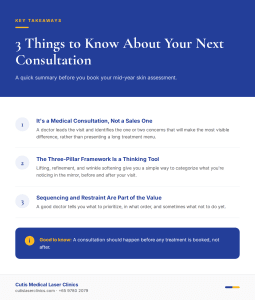
- A Cutis consultation is a medical consultation (not a sales pitch). It is led by a doctor who takes the time to understand your skin and recommends a focused, personalized approach, instead of presenting a long list of treatments.
- The Lifting–Refinement–Wrinkle Softening framework is a thinking tool patients can use to categorize what they’re noticing in the mirror, before and after their clinic visit.
- Sequencing and restraint are part of the clinical value. A good doctor tells you what to prioritize, in what order, and sometimes what not to do yet.
Halfway through the year, your skincare routine is probably running on what’s familiar. And while sticking to a daily regimen matters in building resilient skin, the sun, weather changes, and drifted routines can all leave a mark. It’s the ideal time to drop what isn’t working and do a preventative check-in.
That’s where a proper consultation comes in. Note that it is not by selling a product or a treatment, but by translating something confusing into a specific, prioritized plan. At Cutis, an MOH-registered aesthetic clinic in Singapore, we build the mid-year consultation around that process.
What a Cutis Consultation Actually Involves
A consultation at Cutis is a medical consultation, not a high-pressure sales pitch. It is led by and starts with a doctor, not a sales consultant, sitting down with you to understand:
- What’s bothering you (concerns)
- What’s changed
- What you’re actually hoping to achieve
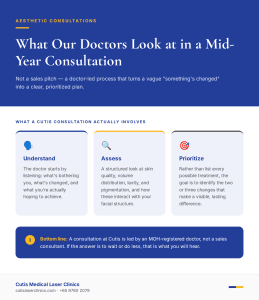
Our doctors assess your skin, understand your concerns, and recommend only what they believe will genuinely help. If the answer is to wait or do less, that is what you will hear. There is no package pressure and no decisions made for you.
From there, the doctor moves into a structured assessment:
- Skin quality
- Volume distribution
- Laxity
- Pigmentation
- How all interact with your facial structure and expressions
The goal isn’t to identify every possible issue or treatment. It’s to identify the two or three things that, if addressed, would make a visible and lasting difference.
The Three-Pillar Framework: Lifting, Refinement, & Wrinkle Softening
To keep things simple, our doctors think and explain in three pillars. It’s not a marketing gimmick; it’s how they actually reason through a case, and a framework you can use when thinking about your own skin.
- Lifting is for structural changes. These include the loss of volume and skin laxity that shows up as sagging along the jawline, cheeks, or midface. This is a matter of support and position.
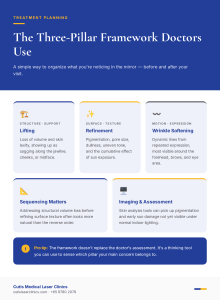
When patients think about it this way, they sense which pillar their main concern belongs to. Sagging along the jaw is a lifting concern. New pigmentation from a summer holiday is a refinement concern. Deepening frown lines are a wrinkle-softening concern.
The framework doesn’t replace the doctor’s assessment; it just gives you a simple way to organize what you’re noticing, before and after your visit.
How the Doctor Decides What’s Most Useful
Not every pillar needs equal attention at every visit; this is where clinical judgment matters most. A doctor considers:
- Which pillar is driving the change you’re actually noticing or concerned about
- How the three pillars interact with each other
- What will produce a result you can see and feel satisfied with, rather than a long list of minor interventions/treatments
Sequencing matters too. Fixing structural volume loss before refining surface texture often looks more natural than doing it the other way around. It’s also why a consultation should happen before any treatment is booked, not after.
And so does restraint. Part of the value of consulting an MOH-registered aesthetic clinic is a doctor willing to say a concern doesn’t need intervention yet, or that a simpler approach will get you most of the way there.
The Role of Imaging and Assessment
Where useful, our doctors supplement the clinical exam with imaging, skin analysis tools that catch what the naked eye can miss, especially under normal indoor lighting. They can pick up:
- Pigmentation not yet visible in daily lighting
- Sun damage accumulating/building up beneath the surface
- Texture changes that are subtle/early
This isn’t about finding more issues to recommend more treatments. It’s about giving doctor and patient a shared reference point, so the plan is based on what’s actually there, not just impressions.
For a mid-year reset in particular, imaging helps flag early sun-related changes before they become visible concerns. These are worth addressing now, gently, rather than later, more intensively.
What Patients Leave With
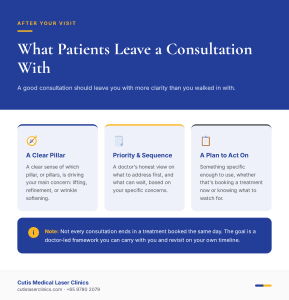
A good consultation should leave you with more clarity than you walked in with. At Cutis, that typically means:
- A clear sense of which pillar (or pillars) is driving your main concern
- A doctor’s honest view on priority and sequencing
- A plan specific enough to act on, whether that’s booking a treatment now or knowing what to watch for and revisit later
Note: Not every consultation ends in a treatment booked the same day. The goal is a clear, doctor-led framework for your own skin, one you can carry with you, refer back to, and use on your own timeline.
If your skin has changed since the start of the year and you’re not sure what to do about it, a consultation is a good place to start. Book a skin assessment with one of our aesthetic doctors at Cutis Laser Clinics.
To share, click on the Icon.