
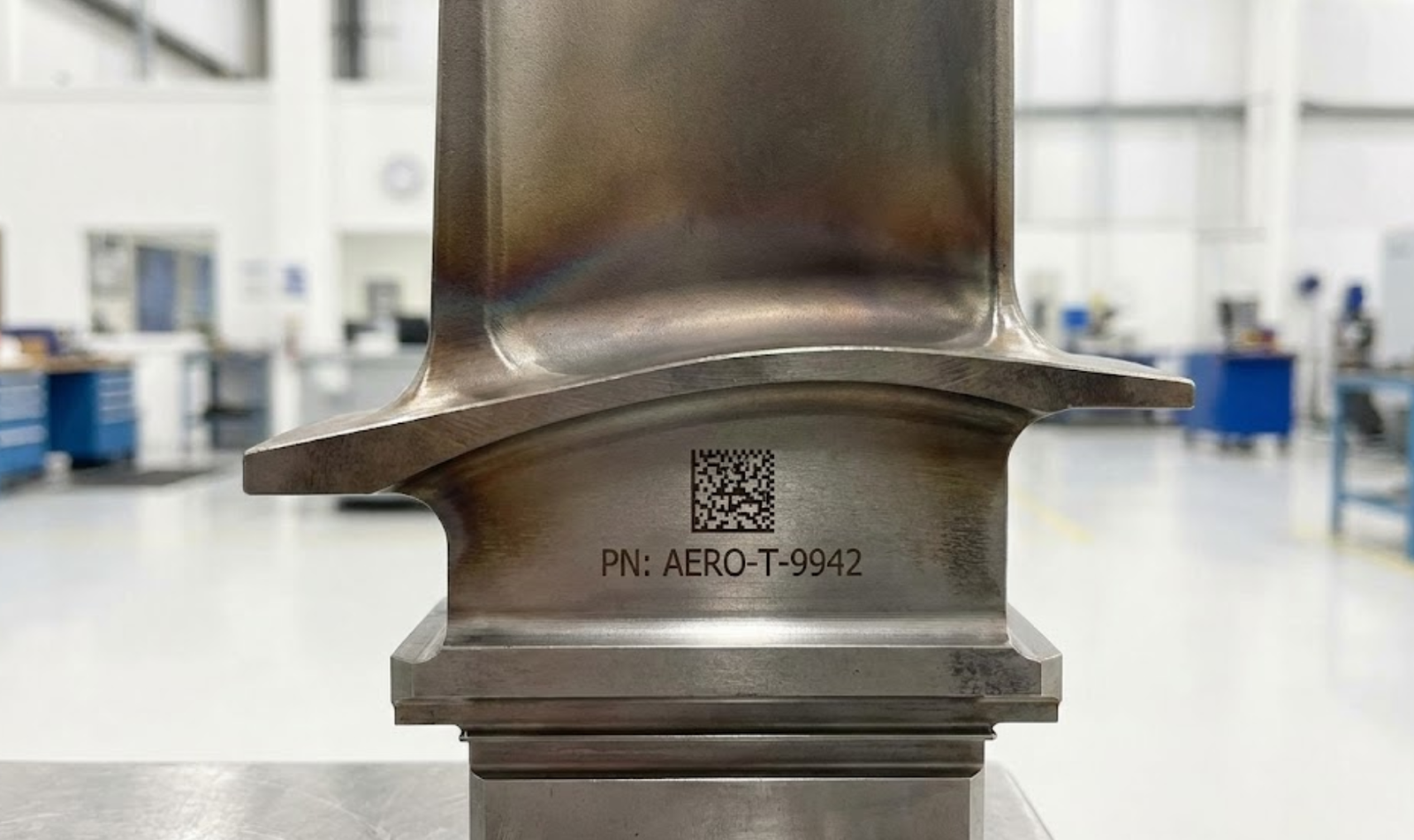
Understanding AS9132: Why Your Scanner Rejects “Perfect” Marks
AS9132 is the aerospace industry’s “rulebook” for Data Matrix codes. Unlike consumer QR codes, aerospace DPMs must withstand decades of extreme thermal cycling, vibration, and chemical exposure.
Core AS9132 Metrics Explained
A. Dot Center Offset (Positioning Accuracy)
This measures how close each dot is to its theoretical center within the Data Matrix grid. If your machine has “slop” in its X/Y axes, the dots will be misplaced.
The Requirement: The actual center of a dot must not deviate from its theoretical center by more than 20% of the nominal dot spacing.
The Physics:
Offset ≤ 0.2 · d
(where d is the distance between cell centers)
B. Fill Ratio (The “Goldilocks” Zone)
The Fill Ratio is the size of the dot relative to the cell size.
Too Small: The scanner cannot distinguish the dot from surface noise.
Too Large: Dots overlap, creating a “blob” that the scanner cannot decode as individual modules.
The Standard: AS9132 typically requires a fill ratio between 60% and 105%.
C. Dot Ovality (Circularity)
A dot must be round. In dot peen marking, an “oval” dot usually indicates a worn stylus or a machine head that is vibrating during the strike. In laser marking, it indicates a poorly tuned galvo scanner.