
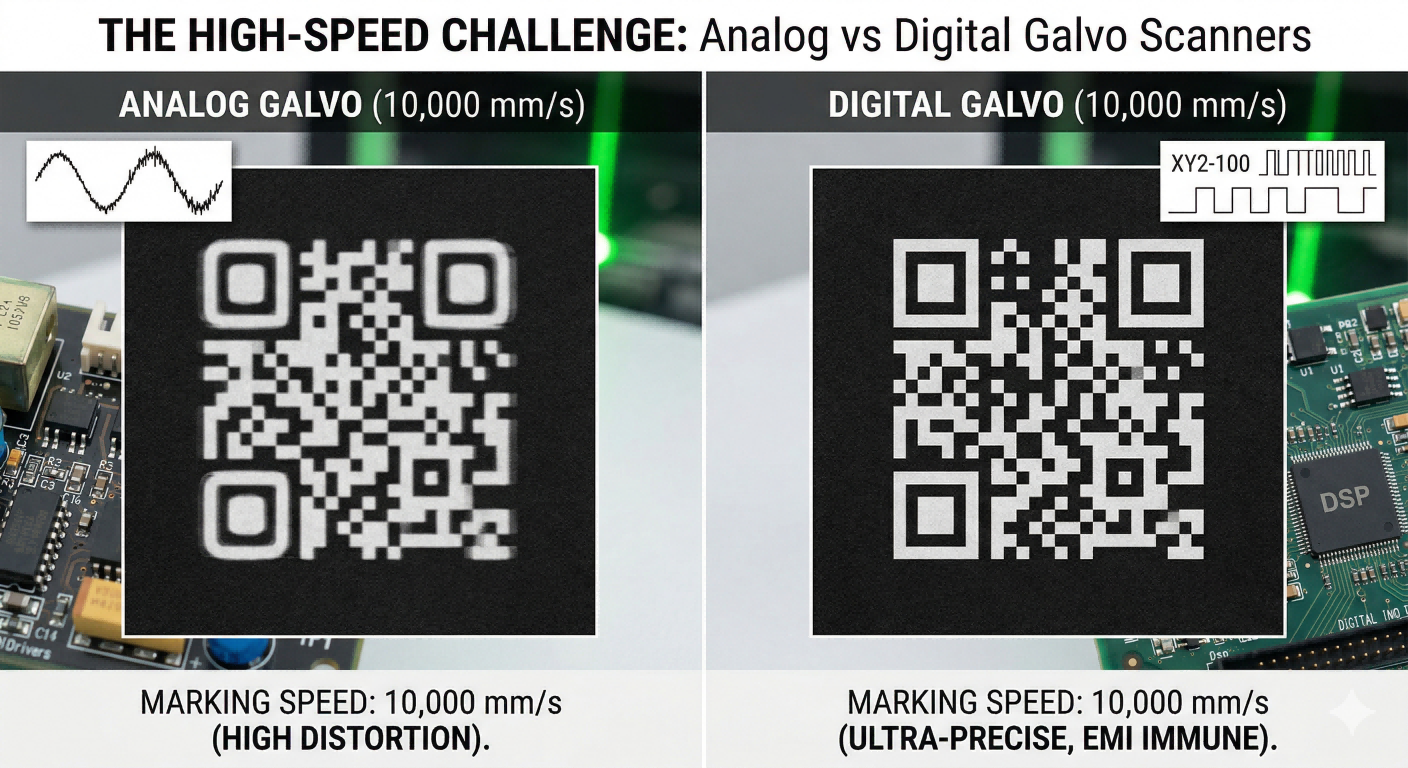
The Physics of Precision: Signal Transmission and EMI
In a modern smart factory, your laser marking machine is surrounded by “noise.” Variable Frequency Drives (VFDs), heavy-duty motors, and high-voltage power lines all emit electromagnetic waves.
The Analog Vulnerability
Analog galvos rely on the precision of a voltage level. If a nearby motor causes a 0.05V fluctuation in the signal line, the analog scanner interprets this as a command to move. This results in “jitter”—tiny, unintended movements of the mirrors.
The Result: Blurred edges, inconsistent line weights, and a higher “reject” rate in high-precision applications.
The Digital Fortress
Digital scanners use a digital servo loop. The controller communicates with the scanner via a high-speed serial interface. Even if a massive amount of electrical noise hits the cable, the digital “1s and 0s” remain readable.
The Result: Absolute position stability. The laser beam goes exactly where the software dictates, regardless of how many other machines are running on the same floor.