
3 Key Takeaways
- The eye area ages differently from the rest of the face. The skin is thinner, more delicate, and always moving. A faint line at the outer corner or a slight heaviness in the lid can show up long before anything else does.
- Not every treatment reaches the layer that’s causing the problem. Surface treatments improve texture and tone, but if your brow has started to droop or your lid feels heavier than it used to, the issue is structural and requires a different depth of treatment.
- There is no single best non-surgical eye lift treatment. What works depends on which layer is driving your concern. A consultation is important to figure out where to start.
We’ve said it before, and we’ll say it again: the skin around the eyes is among the first places on the face to show signs of aging. What time has been doing can show up around this area before anywhere else. You might notice a subtle crease at the corner, a slight heaviness to the upper lid, or an undereye hollow that wasn’t that visible last year.
There is a specific anatomical reason for this. The periorbital area (the skin, fat, muscle, and tissue surrounding the eye socket) is structurally different from the rest of the face. While it allows for constant eye movement, it is also the thinnest skin on the body, has less collagen and elastin, and has almost no sebaceous or oil glands.
Aging in the eye area, however, isn’t one problem. It’s actually several different concerns happening at different layers, and each layer responds to a different kind of treatment or non-surgical eye lift options in Singapore. Understanding this is key to knowing why some solutions work for certain concerns and not others.
Why the Eye Area Shows Aging First
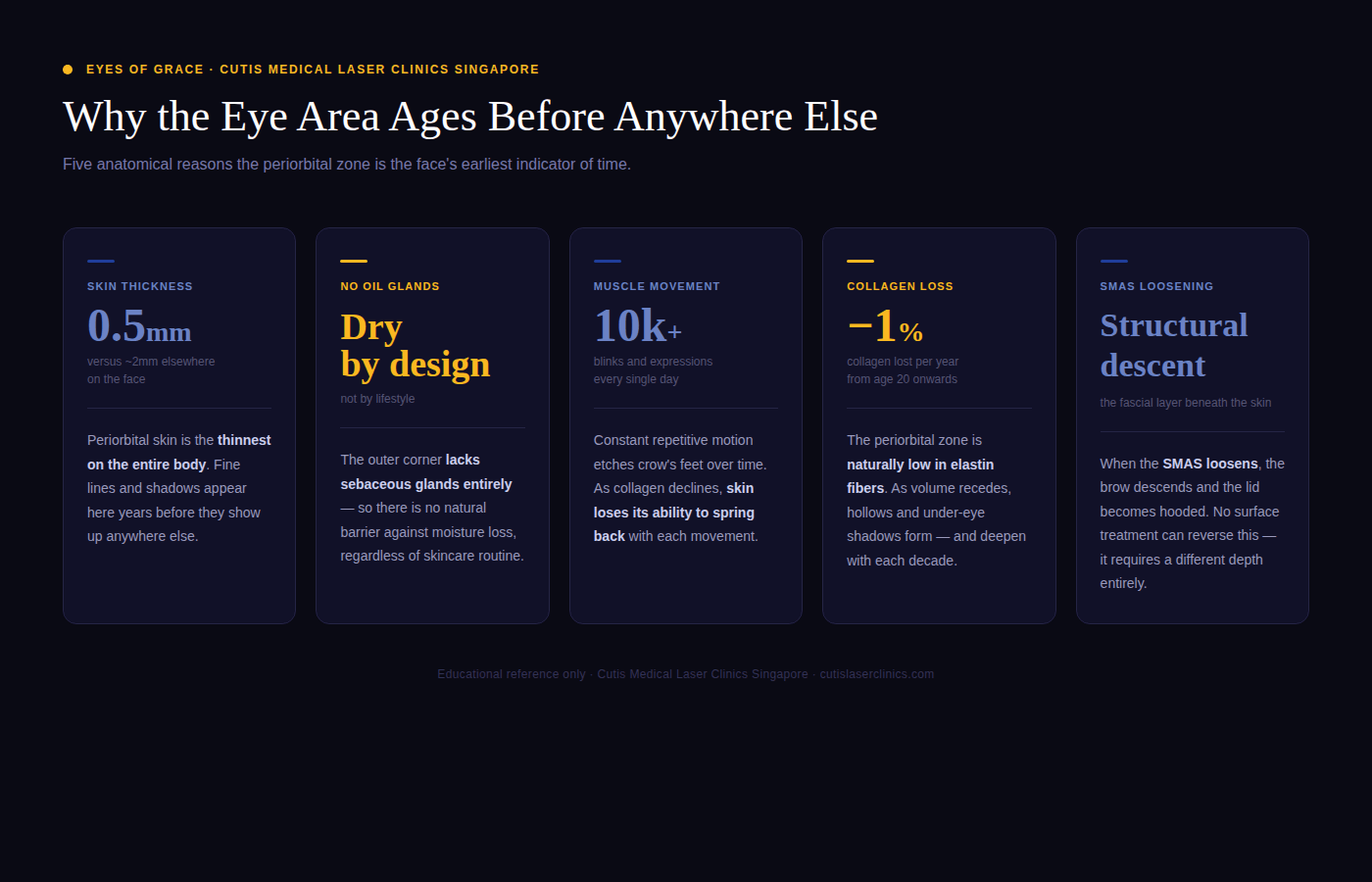
Before we dive into the treatments, it is worth knowing what’s actually happening beneath the surface. There are several reasons the eye area ages faster and more visibly than other parts of the face:
The skin is thin and delicate. As previously mentioned, the skin around the eyes is significantly thinner (0.5mm) than the entire face (about 2mm). This make is highly susceptible to creases, fine lines, and texture changes.
There are no oil glands at the outer corner.
Apart from being significantly thin, the skin on the outer eye has almost no sebaceous glands. This means it has no natural moisture barrier or lubrication, making it more prone to dryness, wrinkling, and early aging.
Daily repetitive movement and facial expressions.
Squinting, blinking, smiling, and other repetitive movements can gradually etch expression lines into the eyes’ outer corners. Over time, the skin loses its ability to bounce back, making those lines more prominent or permanent.
Collagen declines with age.
From our mid-twenties onward, we lose about 1% of our collagen each year. And since the periorbital area naturally contains less collagen and elastin, volume loss and hollowing often appear here first. This then creates shadows or a deepening groove between the lower eyelid and cheek.
The underlying structure loosens.
Underneath the skin, a layer of fibrous tissue called the SMAS (more on this below) holds everything in place. This gradually loosens with age, causing visible changes, like drooping brows, heavier upper lid, and the onset of sagging.
The Anatomy of the Periorbital Area: 3 Layers of Eye Area Aging
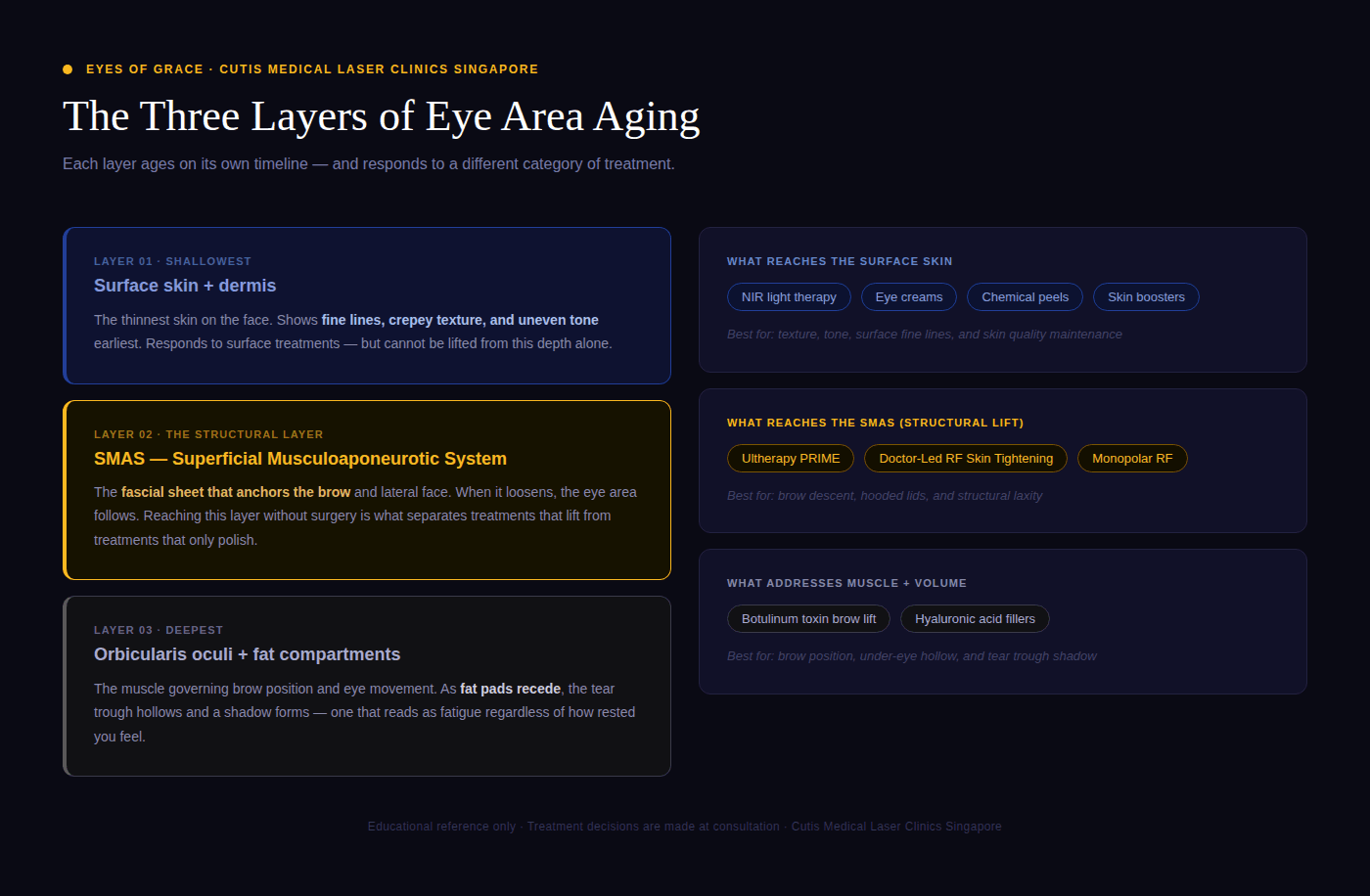
When treating the eye area, it helps to understand the structure you are dealing with. The common reason treatments underdeliver is that they are addressing the wrong layer for the patient’s unique concern.
Layer 1: The Surface Skin
This is the area you can see and touch, and where the first visible signs build up. The most common signs include fine lines at the outer corner (crow’s feet), crepey texture across the lid, dullness, and uneven skin tone.
Surface-level solutions can improve the quality and texture of this layer. These include:
These solutions can be beneficial in any eye care plan, but they have their limitations. It is important to note that they can’t address the deeper layers, which is where most structural aging happens.
Layer 2: The SMAS
The SMAS (superficial musculoaponeurotic system) is a fibrous tissue layer that sits between the skin and the deeper facial muscles. It connects the skin to the underlying muscle, acting like a support structure for the face. When it loosens with age, the soft tissue it was holding in place can start to droop.
In the eye area, this is what causes the lateral brow to descend, the upper lid to appear heavier, and the overall eye zone to sink and flatten. SMAS is actually targeted in surgery, but there are a few energy-based treatments that can lift this zone without cuts or needles.
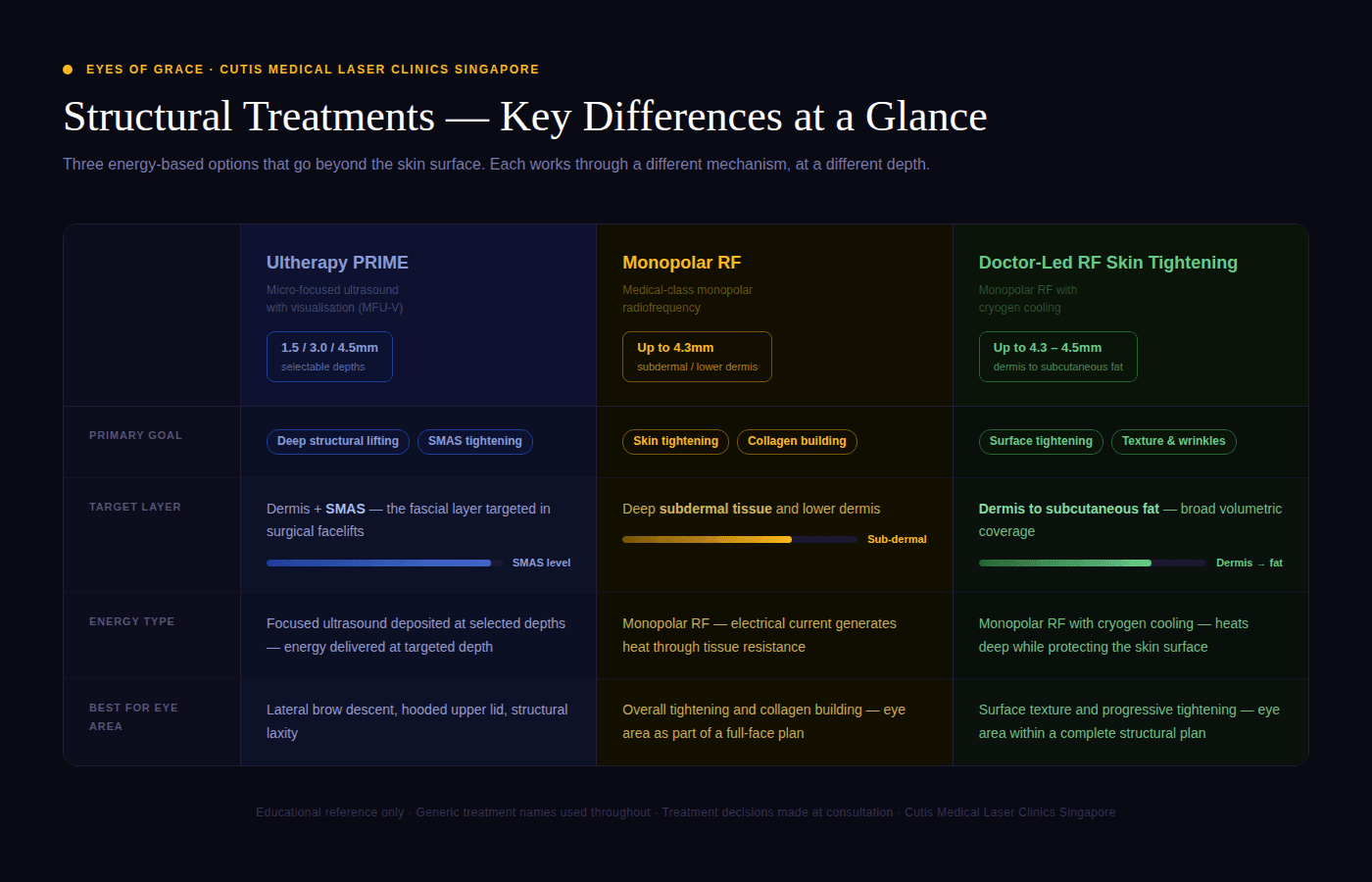
Ultherapy PRIME in Singapore is US FDA-cleared and clinically tested to reach this depth. It uses microfocused ultrasound energy below the dermis, triggering new collagen production. What makes it different is the use of real-time imaging that allows doctors to see the tissue layers before and during treatment. In the eye zone, Ultherapy PRIME can:
- Tighten and lift the tissue from below
- Improving brow position or drooping
- Reducing heaviness in the upper eyelid
RF treatments (Doctor-Led RF Skin Tightening and Monopolar RF) can also deliver heat deep into the dermis to stimulate collagen contraction and remodeling over time. These are typically delivered as full-face treatments with the eye area included as part of the overall plan.
Layer 3: Muscle and Volume
Beneath the SMAS, the orbicularis oculi muscle (beneath the eyelid skin) wraps around the eye socket. This controls how the eyelid moves, how the eye closes, and how the brow is held. As this muscle ages and as the fat compartments above the cheekbone begin to reduce, two things happen:
- The brow loses the lift that kept it lifted
- The tear trough (the groove from the eye’s inner corner down the upper cheek) deepens into a hollow that appears as a shadow
Instead of energy-based ones, these eye concerns respond best to injectable treatments, which may include:
Botulinum Toxin is carefully injected into the muscles that pull the brow downward, allowing the natural lifting force of the forehead to work more efficiently. This produces a lateral brow lift that can open the eye area.
Hyaluronic acid filler (placed conservatively) at the tear trough can restore the contour and reduce the shadow. Do take note that tear trough filler is one of the more technique-sensitive areas in aesthetic medicine, which is why a thorough assessment is essential before proceeding.
Surface vs. Structural: Why the Difference Matters for Treatment
Many patients who are concerned with aging around the eyes have probably tried the surface solutions first. These include a quality eye cream, maybe a brightening serum, or perhaps a chemical peel or two.
While valuable and can deliver minor improvements, they don’t reach the SMAS. They don’t lift the brow position and restore volume in the tear trough.
With structural concerns, no amount of topical care can address those issues. The concern and the treatment need to be matched to the same layer. This is especially true for a:
- Descending brow
- Hooded or drooping eyelid
- Hollow under the eye
The opposite is equally true: if your main concern is skin texture or early fine lines, structural treatments are more than what you need. Surface-level solution or maintenance is the more appropriate choice.
Common Eye Area Concerns and Which Layer They Belong To
Here’s a quick guide to help you know and understand where your concern is likely coming from. This is not a substitute for a proper clinical assessment, but it can help shape your expectations going into a consultation.
Hooded eyelids
are mostly a structural concern. When the lateral brow droops, it causes the upper lid to descend too. Ultherapy PRIME and/or Botulinum Toxin brow lift can address the underlying cause.
Crepey skin on the eyelid
is a surface skin concern. NIR Cinderella and skin quality treatments can address the texture without the need for deeper structural intervention.
Dark circles or under-eye shadows
are often a volume concern. Instead of actual pigmentation, the shadow is typically caused by a hollow tear trough. Hyaluronic acid filler can restore the contour. Pigment-based dark circles require a different approach, which your doctor will assess separately.
Sagging brows
are a combination of structural and muscular concerns. The SMAS loosens, and the muscles that pull the brow downward start to droop more. Ultherapy PRIME can address the structure; Botulinum Toxin can help with the muscular issue.
Crow’s feet
are mostly a muscular concern caused by repeated facial expressions. Botulinum Toxin is effective and US FDA-cleared for targeting these lines.
General collagen loss
around the eye area is a multi-layer concern. It can benefit from a maintenance program combining structural treatment (energy-based) with surface-quality upkeep (NIR or RF).
How Ultherapy PRIME Works at the SMAS Layer
Ultherapy PRIME is a US FDA-cleared device for non-surgical lifting of the skin on the brow, neck, chin, and décolletage. It uses micro-focused ultrasound with real-time visualization, targeting the same layers as a traditional facelift (SMAS). It works with the body’s collagen-building process to restore the skin’s firmness.
When the ultrasound reaches the SMAS layer, it generates controlled heat that bypasses the skin surface. The tissue’s temperature rises briefly to about 60 to 70°C, creating a controlled thermal response. This triggers the body’s wound-healing mechanism response and starts producing new collagen (neocollagenesis).
Existing collagen contracts and over the following 3 to 6 months, these processes combine to tighten and lift the tissue from below. It helps improve the lateral brow position, reduce upper lid heaviness, and firm the overall eye area.
The enhanced real-time imaging allows doctors to see the tissue layers before and during energy delivery. As the physician can identify and target the SMAS directly, the energy is delivered at the layer intended instead of through surrounding tissue.
Near-Infrared (NIR) and Radiofrequency at the Surface Layer
Not every concern in the eye area calls for a structural intervention. For skin quality issues (crepey texture, surface-level lines, uneven tone), treatments that work at the dermal and sub-dermal level may be enough. They are also an important part of maintaining the results of deeper treatments between sessions.
How NIR Skin Tightening Works
Near-infrared (NIR) skin tightening delivers light energy that penetrates to the dermis, stimulating collagen production. It addresses the texture, tone, and early-stage fine lines around the eye, without reaching the structural depth that Ultherapy does.
It is not painful: most patients describe a gentle warming sensation. For patients whose concern is primarily skin quality rather than structural changes, NIR may be the right starting point on its own or as part of a maintenance program.
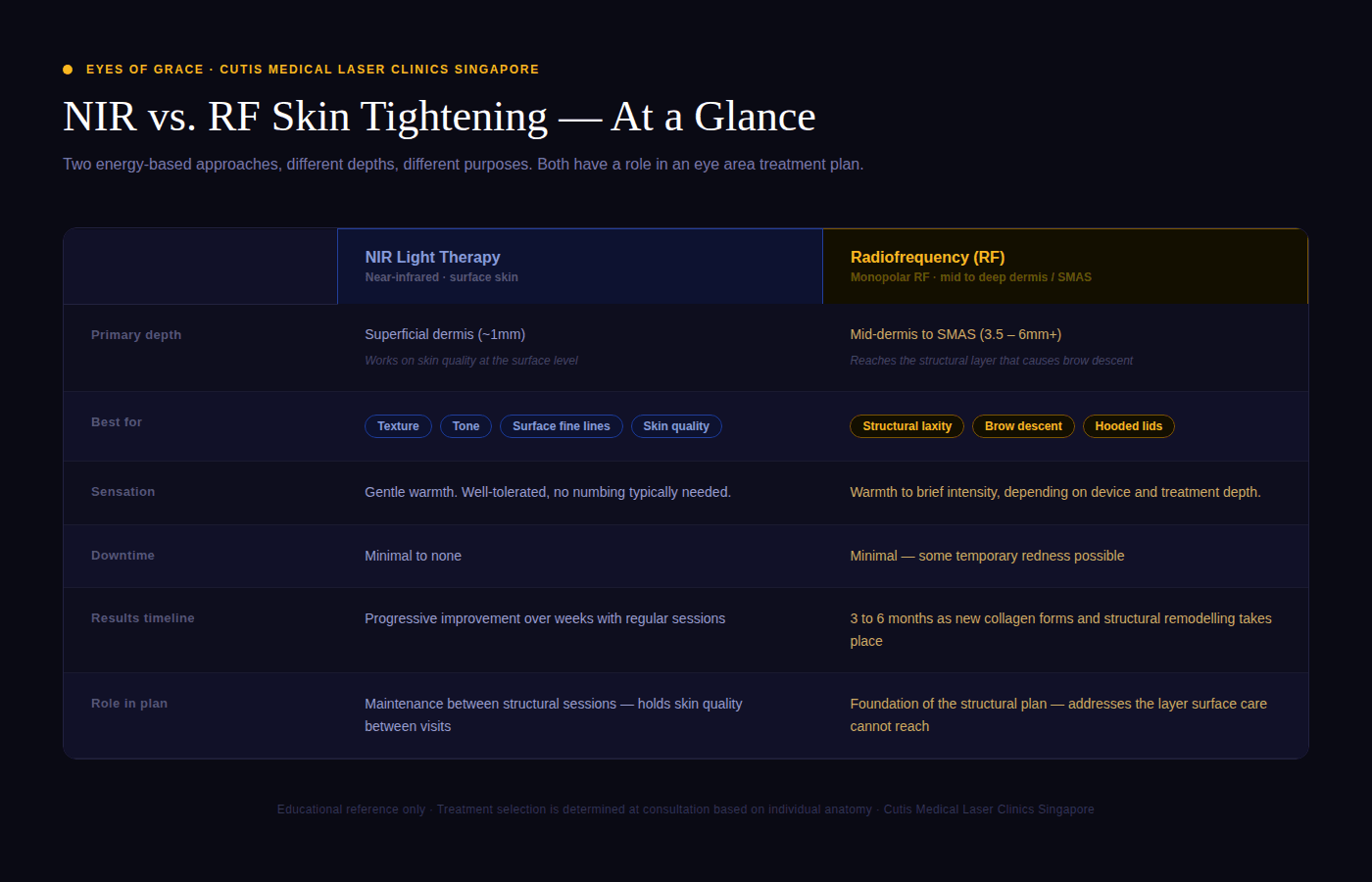
NIR vs RF Skin Tightening: What is the Difference?
Both near-infrared light and radiofrequency (RF) produce heat in the skin and stimulate collagen remodeling. The difference is in how the energy is delivered, how deep it reaches, and what it is most effective for.
- NIR typically addresses the more superficial dermal layers, helping tighten, tone, and rejuvenate the skin from within. It delivers a natural “Cinderella effect” that leaves you looking refreshed and event-ready.
- Monopolar RF energy penetrates more deeply and can produce structural tightening in addition to surface improvement. It can be used to treat both the face and the body.
- Doctor-Led RF Skin Tightening targets the mid-to-deep dermis, stimulating collagen, with results building progressively over 3 to 6 months.
FAQ: What Patients Actually Want to Know
Is NIR skin tightening painful?
There may be some slight discomfort, but the sensation is not painful but warm, which is similar to being on a sunbed. The handpiece, furthermore, has a built-in cooling system for improved comfort. No numbing is typically required.
Does Ultherapy hurt?
Most patients feel warmth and a brief tingling sensation as the energy is delivered. Comfort varies depending on the area being treated and individual sensitivity. Your doctor can discuss pain management options at your consultation.
What is Ultherapy downtime and recovery time?
Most patients return to normal activities right away. Some temporary redness, mild swelling, or tingling may occur in treated areas, but these typically resolve within hours to a few days.
How long do Ultherapy results last?
Optimal results from Ultherapy PRIME develop over 2 to 6 months as new collagen forms, and can last a year or more. But because aging continues, maintenance is a part of any long-term plan.
How many Ultherapy sessions will I need?
Many patients are satisfied after a single session. The number of sessions recommended depends on your anatomy, the severity of laxity, and your aesthetic goals. Your doctor will give you a candid assessment at the consultation rather than a standard recommendation.
What are Ultherapy side effects?
Reported side effects are generally mild and temporary. These may include brief redness, localized swelling, tenderness, or tingling at the treated sites. Rarely, a brief period of altered sensation may occur. All side effects are discussed thoroughly at the consultation before treatment begins.
What is the non-surgical eye lift recovery time?
For energy-based treatments like Ultherapy PRIME, recovery time is minimal. Most patients return to work and normal activities the same day.
For injectable treatments like botulinum toxin or tear trough filler, minor bruising at the injection site can occasionally occur and resolve within a few days. There is no surgical recovery involved in any of these treatments.
What is the best non-surgical treatment for sagging eyelids?
There is no single answer without a clinical assessment. The right approach depends on your concern and the layer driving the concern.
If structural laxity in the SMAS is causing brow descent and lid heaviness, Ultherapy PRIME or one of the RF options is likely the starting point.
If the issue is muscular imbalance, botulinum toxin brow lifting can help the muscle pulling the brow down. Both approaches are often combined in the same plan.
What to Expect at a Consultation
At Cutis, a consultation for eye area concerns is a clinical conversation. It focuses on understanding the causes of your concern and identifying the most appropriate treatment approach.
During your consultation, your doctor will assess:
- Which layers of the eye area are contributing to your concern
- The degree of structural change that is present
- Which treatment options are most suitable for your anatomy and goals
It is important to remember that not everyone is a candidate for every treatment. At Cutis, we will be transparent if a different approach is a better fit for your concern or anatomy.
If your primary concerns involve the lateral brow and upper eyelid area, the consultation will typically focus on:
- Structural treatment options such as Ultherapy PRIME or one of our monopolar RF platforms
- Whether a Botulinum Toxin brow lift would enhance the treatment plan
- What a realistic maintenance schedule may look like between visits
Ready to understand what your eye area actually needs?
Don’t let the area around your eyes make you look tired, sad, or older even when you’re not. Contact Cutis Medical Laser Clinics in Singapore today and schedule a consultation with our aesthetic doctors to find out which treatments are right for you.
To share, click on the Icon.