
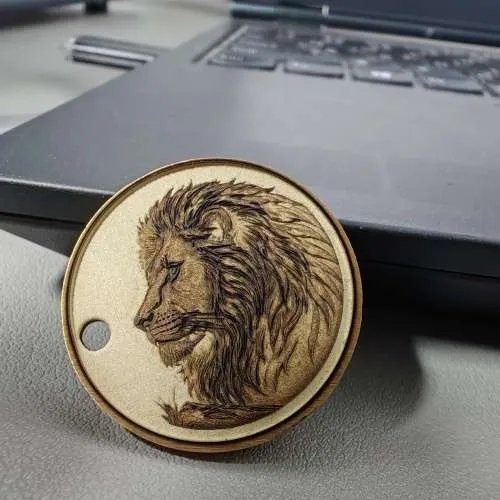
Head-to-Head: Engraving Depth, Precision, and Speed
Engraving Depth and Wall Quality
Standard 2D fiber lasers generally max out their effective deep relief quality at around 2mm on flat sheets. Beyond that depth, the beam loses focus completely, causing speed to drop and walls to distort. 2.5D and 3D systems remove this barrier. Because they constantly recalculate focal placement, they can carve deep, ultra-clean cavities into steel or aluminum without depth performance penalties.
Precision and Detail on Metal Surfaces
Operating at a 1064nm wavelength, fiber lasers are highly optimized for absorption across the entire metallurgy spectrum. High-resolution ytterbium-doped laser sources ensure that fine lines, tiny characters, and intricate micro-patterns remain perfectly crisp. Both 2.5D and 3D platforms easily handle flat and slightly uneven metal surfaces with incredible clarity.
- Laser Etching:Rapid, high-contrast surface marking for labels and tracking data.
- Deep Engraving:Massive pulse ablation for high-margin 3D reliefs and mold matrices.
- Laser Annealing:Dark, localized surface changes without physical depth penetration.
Speed, Efficiency, and Cost Factors
While a standard 2D laser is incredibly cost-effective for high-speed surface tagging on large batches of tools or tags, it loses efficiency if forced to execute repetitive depth runs. Thanks to its automated layer tracking, the 2.5D system (HS-FL35D) can process up to 5,000 mm/s continuously without requiring manual operator refocusing breaks, rendering it faster than 2D and far more affordable than 3D systems.