
3 Key Takeaways:
- Hormones affect hair growth cycles. Hormones like androgens, estrogen, and cortisol can affect how hair grows, sheds, and regrows in different body areas.
- Hormone-sensitive areas require more sessions. Areas such as the face, chin/jawline, neck, and bikini line often require more sessions or maintenance treatments because of hormonal stimulation.
- Proper laser settings and medical guidance matter. Doctor-led treatments and customized laser settings safely target follicles while minimizing risks like irritation or paradoxical hyperplasia.
When it comes to removing unwanted hair, laser hair removal fares better than conventional methods like waxing or shaving. This is because it targets the follicles or root cause of growth instead of just cutting the hair or ripping it from the root. This can then reduce irritation, cuts, and burns, as well as eliminate ingrown hair.
Laser hair removal is effective for long-term hair reduction, yet some areas respond faster than others. Legs and underarms often show quick results, while other areas, such as the face, jawline, neck, and bikini line, can feel more stubborn. The reason, for the most part, is not the laser; it’s hormonal influence.
Our aesthetic clinic recognizes how frustrating it can be when the results feel slow. This makes it important to understand how hormones affect hair growth to help set realistic expectations, reduce unwanted side effects, and tailor treatment using laser hair removal in Singapore.
For further reading: How it Works: The Science Behind Laser Hair Removal
How hormones affect hair growth
Hormones fluctuate throughout the year, and changes in their level can affect body and facial hair. Sex hormones like testosterone and estrogen can influence the hair growth cycle, which consists of four stages.
Hair growth cycle
-
- Anagen (growth) – is the active phase when hair grows and cells in the follicle rapidly divide. It is the longest of all the phases and lasts about two to seven years. Hormones can determine the length of this stage.
- Catagen (transition) – signals the end of the active phase. It is a short stage that lasts about 1 to 2 weeks, when hair growth stops, and the follicle detaches from its blood supply. Hormonal fluctuations can signal hair follicles to enter this phase prematurely.
- Telogen (resting) – is the period when hair remains in the follicle without growing for several weeks to months before new hairs start forming. Hormonal imbalances can disrupt the telogen phase and lead to increased shedding.
- Exogen (shedding) – is when old hair falls out, allowing new hair to grow. Hormonal fluctuations can speed up or slow down this process.
Hormones and their impact
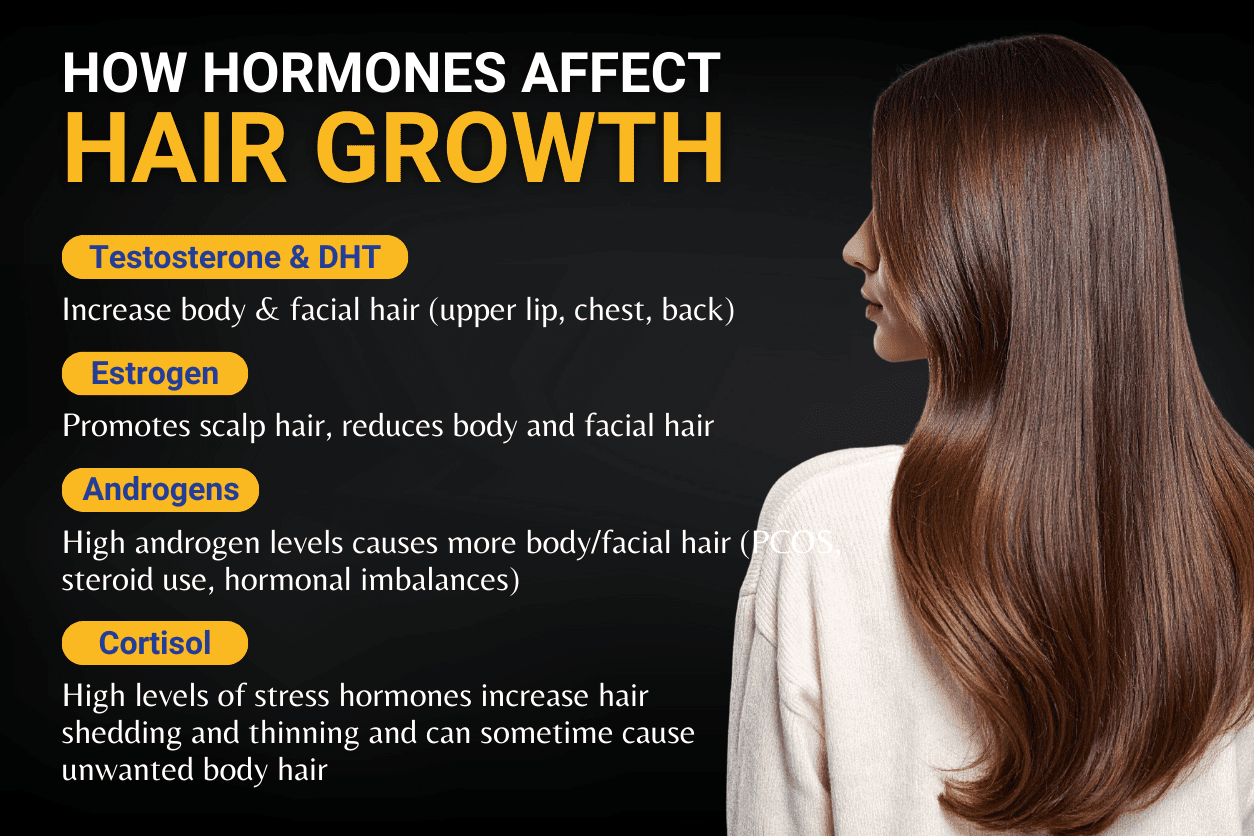
- Androgens – are a group of hormones that regulate hair growth. High androgen levels can increase body and facial hair. They can also contribute to scalp hair thinning in some people, especially with hormonal imbalances or conditions like PCOS.
- Testosterone & DHT – testosterone converts into dihydrotestosterone (DHT). DHT can stimulate hair growth in both the body and face (upper lip, chest, and back), and excess levels can contribute to scalp hair loss. High DHT levels are linked to male and female-pattern baldness.
- Estrogen – supports healthy scalp hair growth and prolongs the hair growth phase. Declining estrogen levels (after childbirth or during menopause) can lead to hair thinning and increased shedding.
- Stress Hormones (Adrenaline & Cortisol) – increased stress hormones can disrupt the hair growth cycle, contributing to hair shedding and thinning, and sometimes unwanted body hair. High cortisol levels may also affect scalp oil balance, leading to dryness or flakiness.
Which areas are more sensitive to hormones?
Areas that are sensitive to hormones are where follicles react strongly to hormonal signals like circulating androgens (testosterone and DHT). They can convert fine hair to thicker, darker hair. These areas are particularly susceptible to hormonal fluctuations during:
- puberty
- pregnancy
- menopause
- conditions like Polycystic Ovary Syndrome (PCOS)
Common hormone-sensitive areas include the:
- upper lip and chin
- jawline and neck
- sideburns
- chest and abdomen
- bikini line
- pubic areas and inner thighs
Hormonal fluctuations can cause these areas to experience regrowth or new hair activation. This is why they often require a customized laser hair reduction approach, with more sessions and maintenance, especially for those with conditions like PCOS.
Why are some areas are harder to treat with laser hair reduction
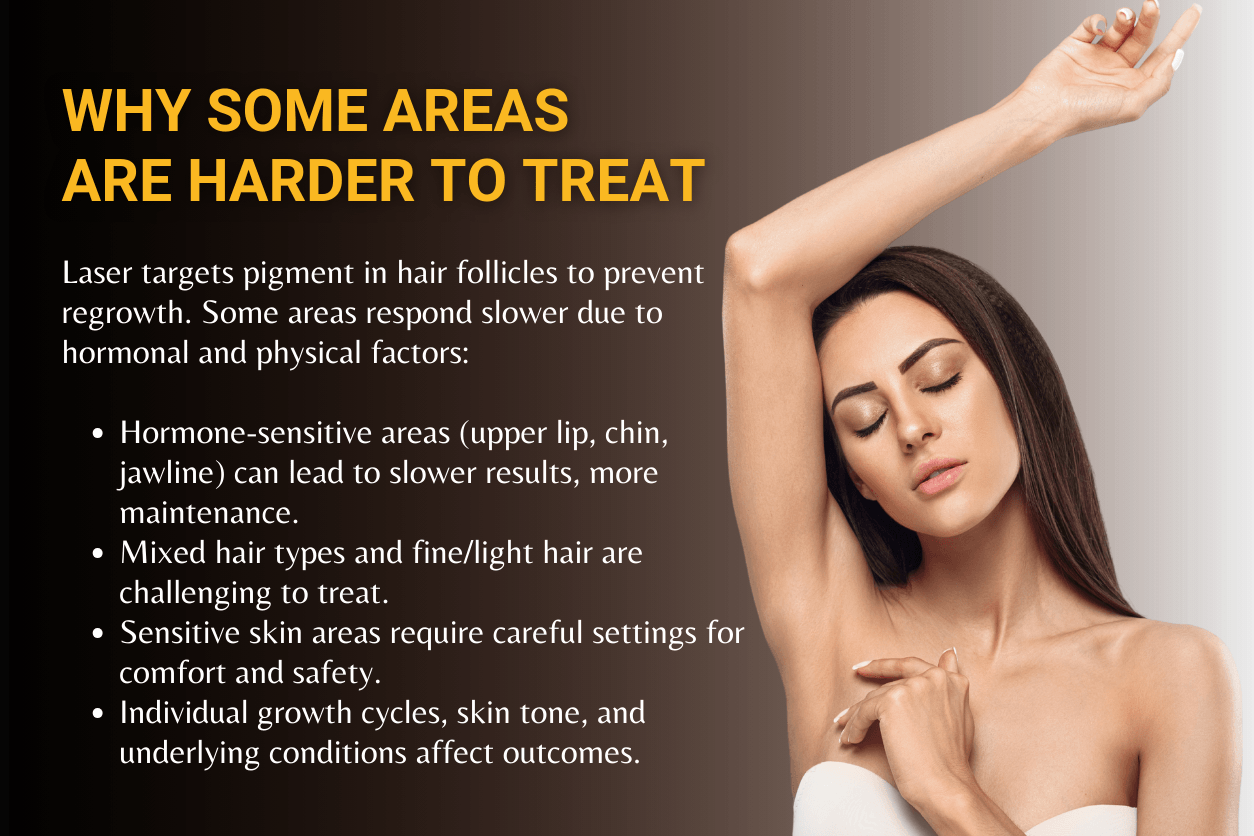
Laser hair removal targets pigment in the hair follicle to disable regrowth. Hormone-sensitive follicles are more resilient due to:
- Mixed hair types – some hormone-sensitive areas have a combination of coarse terminal hairs and fine vellus hairs. Fine hair is more challenging to treat and can be stimulated in some cases, particularly with incorrect settings or treatment.
- Follicle stimulation – continuous hormonal signals promote regrowth even after laser hair removal treatment. Hormones can cause hair to regrow faster or activate dormant follicles. This can mean more sessions or maintenance needed.
- Stimulated growth risk – low-level heat can stimulate dormant follicles, causing paradoxical hypertrichosis (an uncommon side effect where fine hair turns into thicker, coarser hair), especially on the face. This is why proper hair selection, settings, and spacing matter a lot.
- Skin sensitivity and texture – sensitive zones, such as the bikini area and inner thighs, usually have thinner skin and more nerve endings. This can increase discomfort and may require specialized laser settings.
- Hair growth cycles – different body parts have varying hair growth cycles. This can affect the frequency of sessions and how quickly you can achieve desired results. Laser hair removal is only effective on hair that is in the anagen or active growth phase.
- Skin tone contrast – A lower contrast between skin tone and hair color makes it harder for the laser to detect the pigment in the hair follicle. Modern technologies, however, offer safe and effective laser reduction for darker skin tones and can bypass melanin to target follicles.
- Underlying medical conditions – hormonal issues such as Polycystic Ovary Syndrome (PCOS) can make treating certain areas difficult. This may require more sessions and long-term maintenance.
How Cutis treats hormone-sensitive areas
- Modern technology – at Cutis, we have Nd:YAG lasers and US FDA-cleared devices that can safely treat different skin tones and hair types. The right wavelength selection targets the follicles without overstimulation.
- Customized/targeted settings – as hair thickness and density can change over time, we adjust laser settings (lower energy or higher frequency) to target the follicle’s blood supply.
- More or longer sessions – the average session for hormone-sensitive areas like the chin is about 8 to 10 sessions. But for patients with hormonal or PCOS-related hair, 10 to 12 (or more) sessions may be recommended.
- Specialized protocol – our clinics may recommend more than the standard laser hair reduction sessions for stubborn hair in certain areas. We may also advise medical management or accompanying treatment to be used alongside lasers.
- Doctor-led treatments – we have doctors on-site to perform or supervise the treatments. We know that laser hair reduction and similar methods require proper training to be carried out safely and can be risky in inexperienced hands.
- Avoiding very fine hair – treating zones with too fine or sparse hair can sometimes trigger hair growth or paradoxical hypertrichosis, an uncommon side effect where hair in treated areas grows darker and thicker.
What results to expect with laser hair reduction
Results vary by hormonal activity, hair type, and consistency. With proper treatment, you may expect:
- Gradual reduction in thickness and density
- Slower progress than non-hormonal areas
- Finer or slower regrowth in some cases
- More sessions compared to legs or underarms
- Maintenance treatments may be required
Note: Even stubborn, hormone-sensitive areas benefit from laser hair reduction in Singapore. When done the right way, the treatment doesn’t stimulate hair growth. Problems are more likely with incorrect settings, treating unsuitable hair, or too frequent sessions.
How patients can support better hair reduction results
- Protect the skin from the sun by applying SPF 30 or higher daily and avoiding the sun’s peak hours.
- Disclose hormonal conditions during consultation.
- Follow recommended treatment sessions or intervals.
- Avoid at-home touch-ups in treatment areas (like waxing or shaving hair regrowth).
- Respect doctor guidance or recommendation on unsuitable areas.
- Be patient and realistic about results and timelines.
For further reading: How to Get the Most Out of Your Laser Hair Removal Treatment
Book a consultation
For stubborn or hormone-driven hair, a doctor-led consultation is important for safe, effective, and long-lasting results. WhatsApp us today at +65 9780 2079 to learn more about our hair reduction treatments or book a consultation with one of our aesthetic doctors in Singapore.
To share, click on the Icon.