
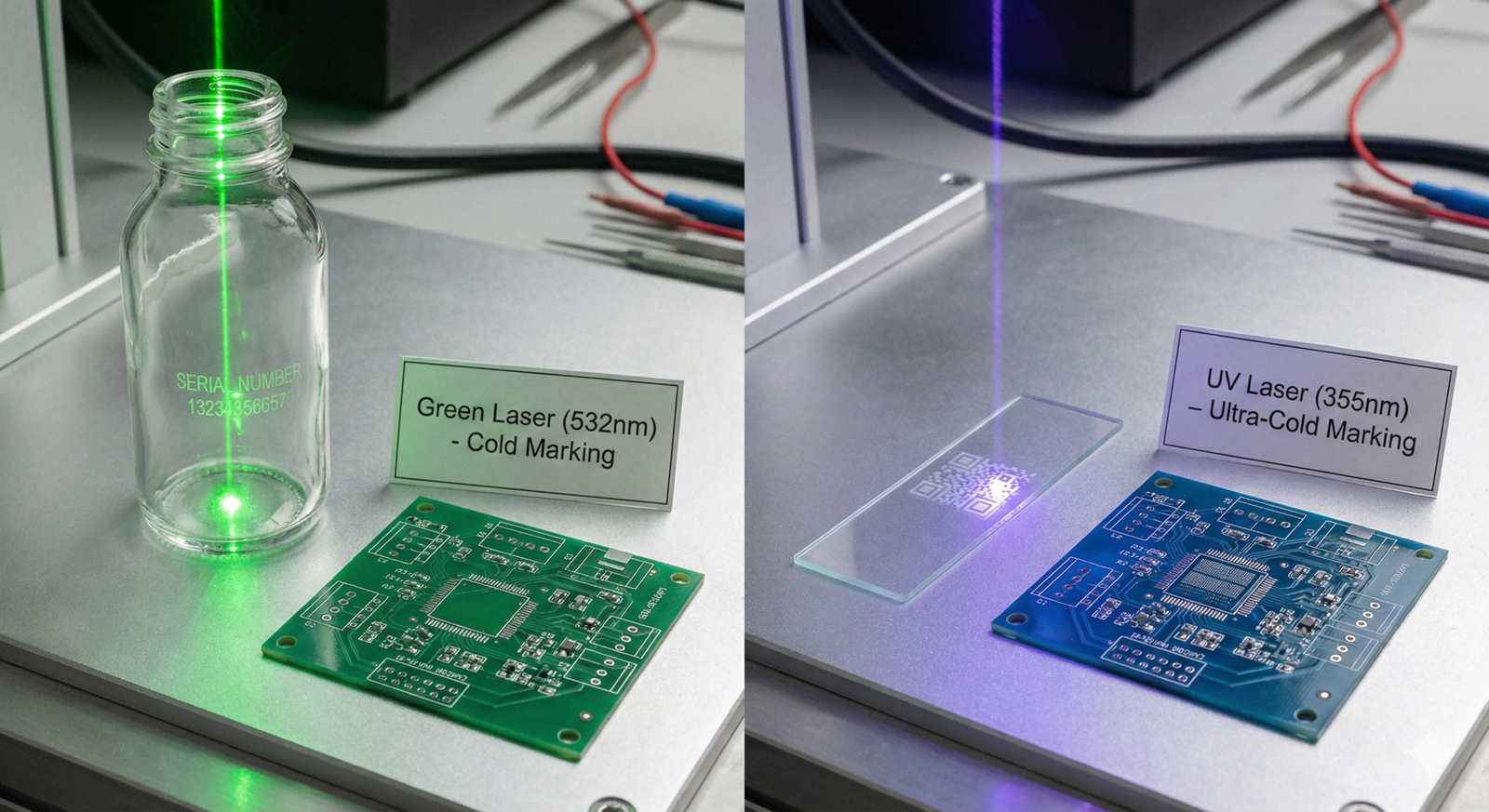
2. The UV Laser (355nm): The “Plastic Surgeon”
Ultraviolet lasers operate at the third harmonic (355nm). This ultra-short wavelength creates photons with extremely high energy. When this beam hits a material, it doesn’t just heat it; it breaks the chemical bonds of the material directly. This process is called Photochemical Ablation.
The Killer App: “Unmarkable” Plastics & FPC Cutting
Have you ever tried to laser mark a white iPhone charger cable or a silicone wristband with a Fiber laser? The result is usually a melted, yellow mess with low contrast.
UV lasers excel here. Because they break bonds photochemically, they can create a dark, high-contrast mark on white silicone, Teflon, and fire-retardant plastics without tactile relief. The surface remains smooth to the touch. This is critical for medical tubing where bacteria could hide in deep engraving grooves.
For the PCB industry, UV is often the only choice. It is capable of cutting Flexible Printed Circuits (FPC) made of polyimide. A CO2 laser would burn the edges, creating conductive carbon soot that short-circuits the board. A UV laser creates a clean, “cold” cut with virtually no carbonization.