Ultrafast sources became production equipment when they stopped needing an optics bench
Fiber-based and sealed architectures removed the alignment, purge and environmental control that kept femtosecond lasers in laboratories.
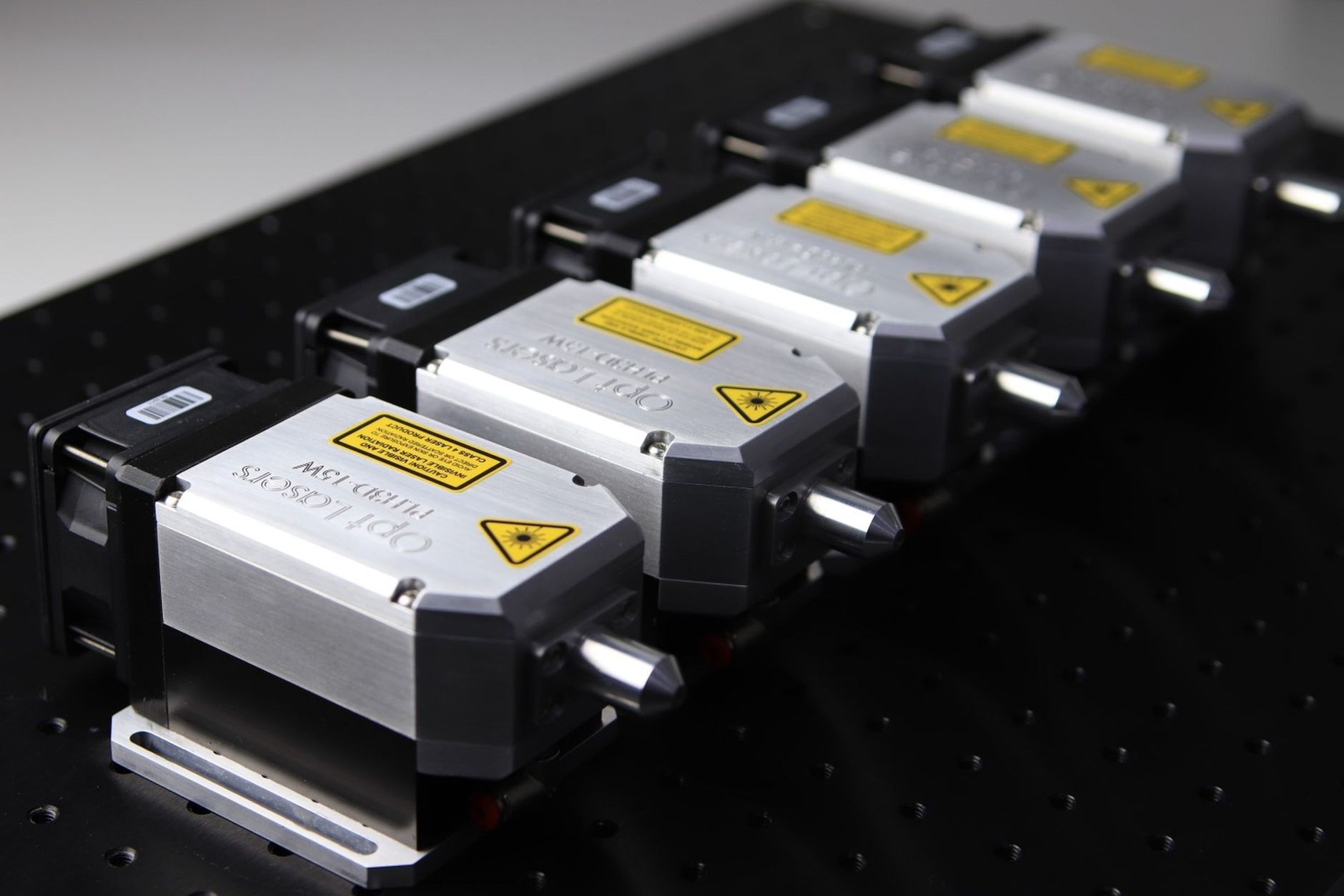
Early femtosecond systems were laboratory instruments: free-space cavities on optical tables, sensitive to temperature, vibration and humidity, requiring regular alignment by someone who understood the cavity. That description disqualified them from production regardless of process capability.
What changed architecturally
Fiber-based oscillators and amplifiers replaced free-space cavities in many designs. Light is confined in fiber rather than propagating through air between discrete optics, which removes most alignment sensitivity. Chirped pulse amplification implemented in fiber and compact bulk stages allowed high pulse energy without the footprint earlier systems needed.
Sealed, purged housings removed humidity and contamination dependence. Thermal management improved to the point where a factory ambient of thirty degrees is acceptable rather than disqualifying.
The specifications that matter in production
Laboratory specifications emphasise pulse duration, peak power and beam quality. Production specifications emphasise different things.
Power stability over shifts rather than over minutes. Drift that would be irrelevant in an experiment becomes a process capability problem across an eight-hour run.
Time to stable operation from cold. A source needing two hours to stabilise costs two hours of every start-up.
Behaviour after interruption. Power failures happen; recovery should not require a specialist.
Serviceability. Whether a failed component can be replaced by a field engineer or requires factory return determines downtime.
The remaining gap
Ultrafast sources are still more expensive and less field-serviceable than fiber lasers for continuous processing. The service network is thinner, and there are fewer people who can diagnose problems on site.
For manufacturers evaluating ultrafast processing, that is the realistic risk: not whether the process works, but what happens on the day the source stops working and the nearest qualified engineer is a flight away.
The mitigation is the same as for any specialised equipment — service agreements that specify response times, and for critical processes, redundancy. It is a supply chain question rather than a technology one, which is itself a sign of how far the technology has come.
This article was produced by the LasersNews AI desk and reviewed by our editors.
Related reading

Ultrafast lasers solved the quality problem. Throughput is the remaining one
Beam splitting, polygon scanning and higher repetition rates are the levers turning femtosecond precision int…
"Cold ablation" is a useful simplification that hides where the heat goes
Femtosecond pulses remove material before heat diffuses. Repeat them at high rates and heat accumulates anywa…
Filamentation cutting made thin glass a manufacturable material
Self-focusing inside the glass creates a column of modified material through the full thickness. The glass th…